What should an invention blueprint include?
A complete invention blueprint covers the problem, how it works, specifications, materials, components, build steps, drawings, and open questions. Here is a checklist, with what the USPTO expects from drawings.
Short answer: A complete invention blueprint includes eight parts: the problem the invention solves, how it works, its specifications, materials, components, build steps, drawings, and a list of what is still unproven. If you plan to file a patent application, the drawings must also follow the USPTO's rules in 37 CFR 1.84, and a nonprovisional application's drawings must show every claimed feature.
The primary sources for the patent sections are the USPTO's provisional application guide and the federal drawing rules, 37 CFR 1.84 and 37 CFR 1.83. This article is general information, not legal advice.
What is an invention blueprint?
An invention blueprint is a written and drawn description of an invention, detailed enough that someone else could understand it, build it, or quote a price for it. It sits between the idea in your head and a prototype or patent application, and it is the document builders, engineers, and patent professionals will ask you for.
What are the eight parts of a complete blueprint?
- The problem. One or two sentences on what it solves and for whom.
- How it works. The principle of operation in plain language, step by step.
- Specifications. Measurable targets: dimensions, weight, power, load, speed, operating temperature, whatever matters for your design.
- Materials. What each part is made of, and why.
- Components. A parts list, including off-the-shelf items such as motors, sensors, fasteners, and batteries.
- Build steps. The order in which the parts go together.
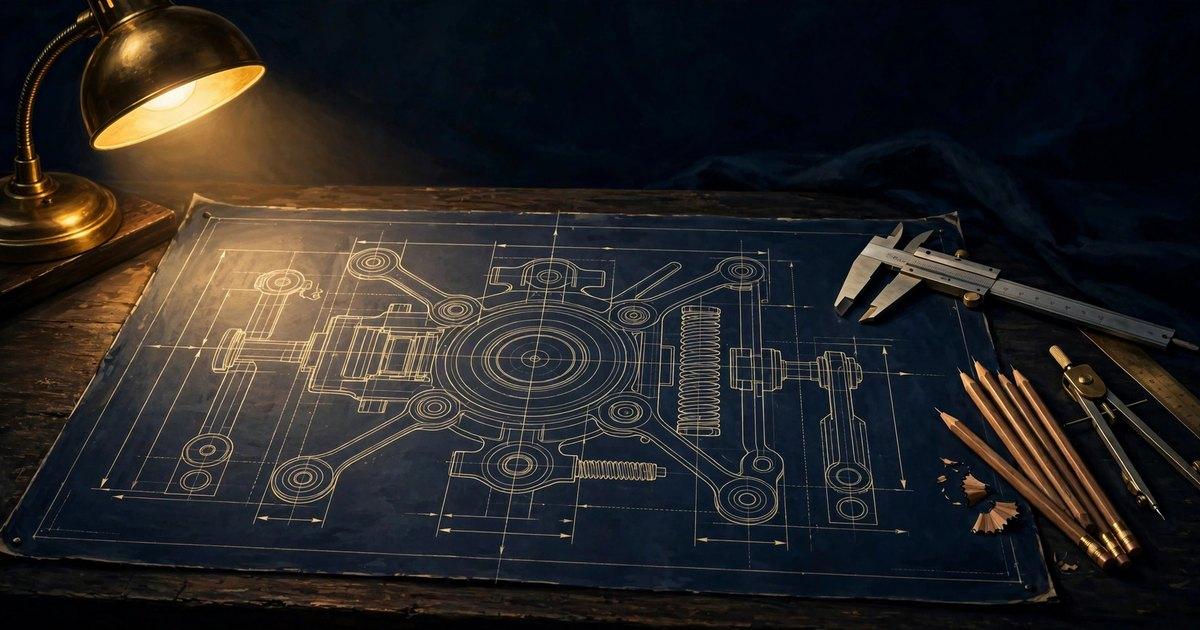
- Drawings. Views that show every part and how the parts relate, with each part labeled.
- Open questions. What has not been tested or proven yet, so no one mistakes a guess for a result.
What do patent drawings have to follow?
If the blueprint will become a patent application, the drawings follow federal rules. Key points from 37 CFR 1.84:
- Black and white. "Black and white drawings are normally required." Color is permitted in design applications, and in utility applications only after a petition is granted.
- Sheet size. All sheets must be the same size: A4 (21.0 by 29.7 cm) or US letter (21.6 by 27.9 cm, 8 1/2 by 11 inches).
- Margins. At least 2.5 cm (1 inch) at the top and left, 1.5 cm (5/8 inch) on the right, and 1.0 cm (3/8 inch) at the bottom.
- View numbers. Views are numbered in consecutive Arabic numerals starting with 1, each preceded by "FIG." A single view is not numbered.
- Reference characters. The same part keeps the same reference number in every view, numbers are at least 0.32 cm (1/8 inch) tall, and every number in the drawings must appear in the description, and the reverse.
- No scale labels. Notes such as "actual size" or "scale 1/2" are not permitted on the drawings.
And under 37 CFR 1.83(a): "The drawing in a nonprovisional application must show every feature of the invention specified in the claims."
Does a provisional application need a full blueprint?
Not every part of it. According to the USPTO, a provisional application gets a filing date only when it contains a written description of the invention that meets 35 U.S.C. 112(a), and it is not required to have formal patent claims. The USPTO gives a filing date even without drawings, but it advises including any drawings needed to understand the invention. A thorough blueprint makes both parts easier to write. Read patent pending vs patented for what a provisional filing does and does not give you.
What do we know, and what is still open?
What is fixed: the drawing rules above are federal regulations, and the USPTO's provisional application requirements are published.
What depends on you: how much detail your blueprint needs. A blueprint for a quick proof of concept can be short. One meant for a builder's quote or a patent attorney should cover all eight parts. Engineering drawing standards beyond patent rules vary by industry, and this article does not cover them.
How does Inventi Matrix build a blueprint?
In other words, it produces most of the checklist above as a starting point, which you then review and refine. A blueprint is also how you get comparable quotes before you build, which we cover in How much does it cost to prototype an invention?. To judge how mature your design is, see What is a technology readiness level (TRL)?.
About Physis Systems
Physis Systems (Physis Defense Systems, Inc.) builds Inventi Matrix, an invention engineering platform available in the United States and Canada at inventimatrix.com, and Lumina AI Companion, a personal AI companion you can meet on the Lumina page.
Frequently asked questions
What is an invention blueprint?
An invention blueprint is a written and drawn description of an invention detailed enough for someone else to understand, build, or quote it: what problem it solves, how it works, its specifications, materials, components, build steps, and drawings.
Do patent drawings have to be in black and white?
Normally, yes. Under 37 CFR 1.84, black and white drawings are normally required for utility applications. Color is permitted in design applications, and in utility applications only after a petition is granted.
Does a provisional patent application need drawings?
The USPTO gives a provisional application a filing date even without drawings, but it advises applicants to include any drawings necessary to understand the invention. This is general information, not legal advice.
What is Inventi Matrix?
Inventi Matrix is an invention engineering platform by Physis Systems. It turns a plain-language idea into a technical blueprint with specifications, materials, components and build steps, then CAD geometry with a 3D preview, engineering drawings, and a patent draft you can refine. Inventi Matrix Pro is available on Google Play in the United States and Canada, and on the web at inventimatrix.com.
Turn your idea into a blueprint with Inventi Matrix
Inventi Matrix is an invention engineering platform by Physis Systems. It turns a plain-language idea into a technical blueprint, CAD geometry with a 3D preview, engineering drawings, and a patent draft you can refine. Available in the United States and Canada.