Is Mars still volcanically active?
ESA's ExoMars Trace Gas Orbiter keeps finding hydrogen chloride above fresh fissures on the Alba Mons volcano. A new study suggests gas from a dormant magma chamber, a hint that Mars is not geologically dead.
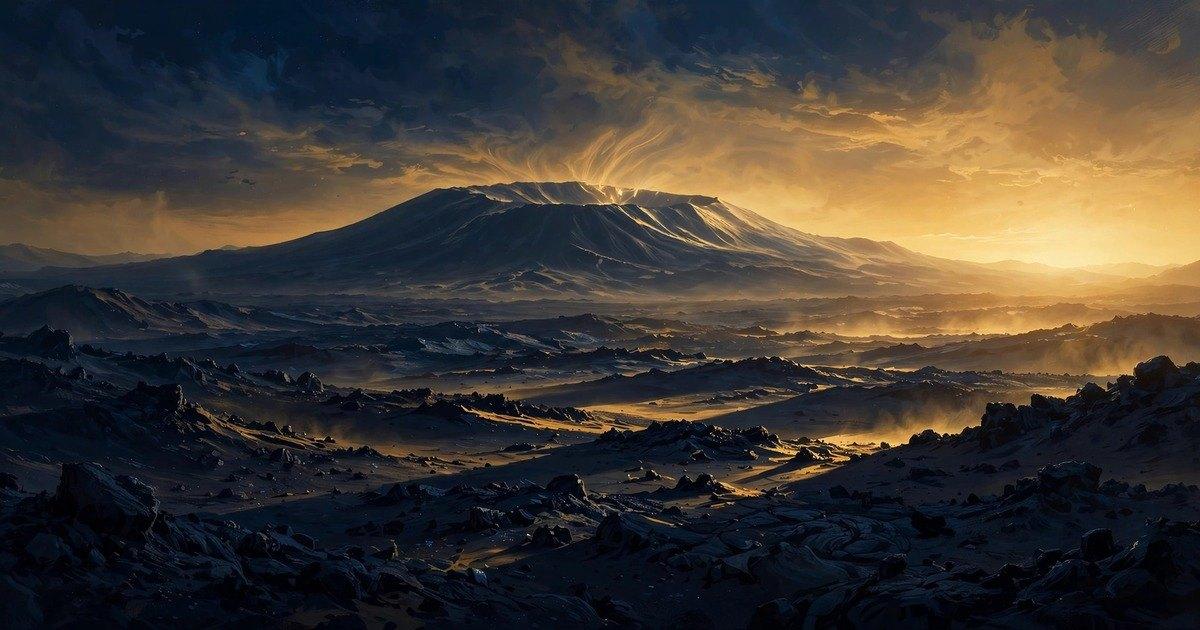
Short answer: Possibly, but it is not confirmed. ESA's ExoMars Trace Gas Orbiter has repeatedly detected hydrogen chloride, a gas commonly found escaping from magmatic vents on Earth, above fresh fissures on the flanks of the Alba Mons volcano. A study published in Science Advances on 4 November 2026 suggests the gas comes from a dormant magma chamber, but no new lava flows or eruptions have ever been observed on Mars.
The primary source for this article is ESA's news release European orbiter detects hints of volcanic activity on Mars, along with ESA's blog post Geological intuition for Mars. The study itself is "Enigmatic HCl detections as a potential signature of igneous activity on Mars," in Science Advances.
What did the orbiter find?
The Trace Gas Orbiter (TGO) first reported hydrogen chloride gas in the Martian atmosphere in 2021. Since then, ESA says, the gas has followed a seasonal pattern, peaking in northern hemisphere winter, and most of that variability appears to be linked with Mars' dust and water cycles.
An international research team led by Alexander Trokhimovskiy, using the infrared spectrometers of TGO's Atmospheric Chemistry Suite, noticed spikes of hydrogen chloride "where it shouldn't have been, and during an odd season." There was one exception to the usual pattern, "always in the same season and at the same place": above volcanic fissures on the flanks of the Alba Mons volcano, in early northern summer. According to ESA's blog, the measured concentrations are of the order of two parts per billion by volume.
Why point to volcanoes?
Two clues line up. First, on Earth this gas is commonly found escaping from magmatic vents. Second, images from TGO's CaSSIS camera showed "fresh and narrow fissures, in some cases hundreds of metres long, associated with colour changes on the surface."
The team suggests the seepage is connected to a dormant magma chamber, with magmatic gases rising through these fissures. ESA's blog says that, of all the possible sources, the magmatic seepage one is "the more likely."
"The Trace Gas Orbiter was able to find the smoking gun," said Daniel Mège, Professor at the Space Research Centre of the Polish Academy of Sciences and a co-lead author of the paper.
Why does the gas only appear in early summer?
The proposed explanation is ice. In winter, with temperatures down to -120°C, ice blocks the gas from escaping. As the ice sublimates in early summer, the trapped gas is released. That would explain why the spike comes back in the same season at the same place.
Is Mars dead, or just dormant?
That is the bigger question, and the study's answer is cautious. "Our findings suggest that Mars has retained enough internal heat to support volcanic activity until recently," Mège said, adding, "and possibly still does."
ESA notes that volcanic gases could have been more abundant in the past, contributing to a thicker atmosphere and warmer climate, which could have allowed liquid water to cover much of the Martian surface.
Colin Wilson, ESA's project scientist for the ExoMars Trace Gas Orbiter, said, "These findings may prove to be TGO's greatest success yet."
Could this help the search for life?
It gives the search a place to look, nothing more. ESA says that "if hydrothermal systems are active, they could contain the ingredients and energy needed for microorganisms to develop." The ESA blog also notes that hydrothermal systems do not need to host living organisms. Nothing in this study is evidence of life.
What do we know, and what is still open?
What is confirmed: TGO measured repeated spikes of hydrogen chloride above fissures on the flanks of Alba Mons, always in the same season, and CaSSIS images show fresh, narrow fissures with surface colour changes at that site.
What is still open: whether the gas really comes from a dormant magma chamber. That is the team's interpretation, not a direct observation, and ESA's own headline calls the result "hints" of volcanic activity. No new lava flows or eruptions have ever been observed on Mars. Whether Mars is still volcanically active today, or was only active until recently, remains an open question, as does whether any active hydrothermal system exists below Alba Mons. We could not access the full paper text, so this article relies on ESA's description of the study.
Why does Physis Systems cover this?
Physis Systems follows research at the frontier, from space to fundamental science. For more stories like this one, visit the Physis Systems blog.
About Physis Systems
Physis Systems (Physis Defense Systems, Inc.) builds Inventi Matrix, an invention engineering platform available in the United States and Canada at inventimatrix.com, and Lumina AI Companion, a personal AI companion you can meet on the Lumina page.
Frequently asked questions
Is Mars still volcanically active?
It is not confirmed. No new lava flows or eruptions have ever been observed on Mars, but a 2026 study of hydrogen chloride above fissures on the Alba Mons volcano suggests gas from a dormant magma chamber may still be seeping out.
What did the ExoMars Trace Gas Orbiter detect?
Spikes of hydrogen chloride gas that kept appearing in the same place and season: above volcanic fissures on the flanks of Alba Mons, in early northern summer. On Earth, this gas is commonly found escaping from magmatic vents.
Why does the gas appear in early summer?
The team suggests the gas is blocked by ice during winter, when temperatures fall as low as -120°C, and escapes as the ice sublimates in early summer.
Does this mean there is life on Mars?
No. ESA says that if hydrothermal systems are active there, they could contain the ingredients and energy microorganisms would need. That makes the area a candidate place to look, not evidence of life.