How could gravitational waves reveal new planets?
Two NASA-led studies show how the future LISA observatory could find planets orbiting pairs of white dwarfs, by spotting the tiny wobble a planet leaves in their gravitational waves.
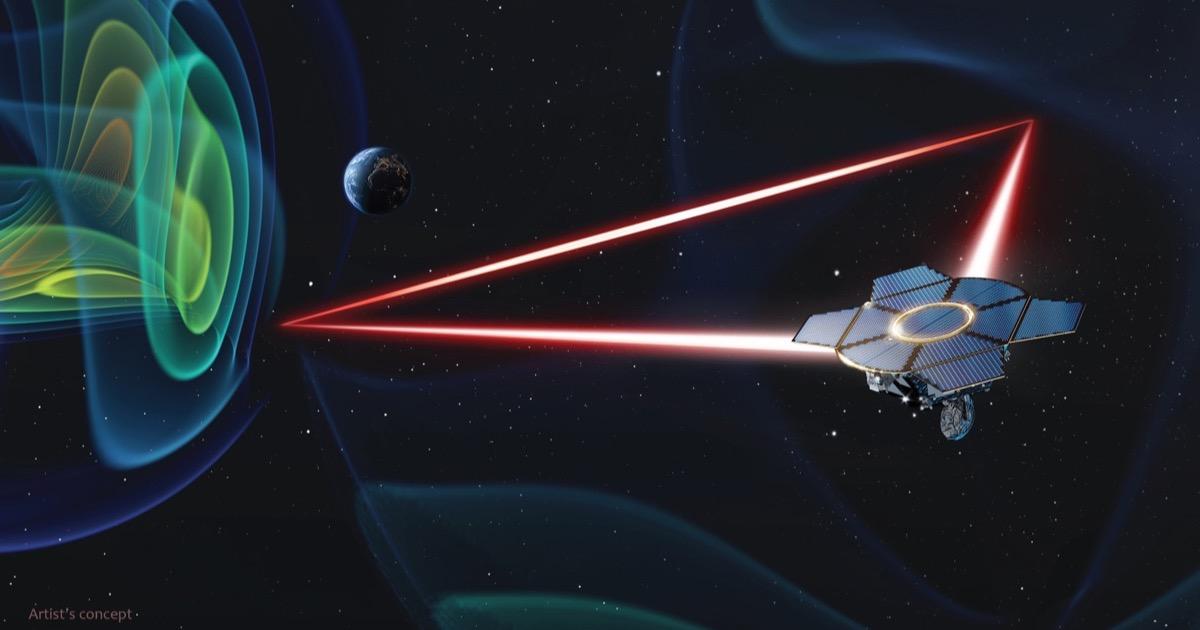
Image: ESA, acknowledgement ATG Europe (artist's concept), CC BY-SA 3.0 IGO
Short answer: Pairs of white dwarfs in tight orbits give off gravitational waves, and a massive enough planet orbiting such a pair makes it wobble, leaving a pattern called sidebands in the signal. Two studies led by NASA astrophysicists, published November 10, 2026, in The Astrophysical Journal, show how the future LISA observatory could use that pattern to find planets around these pairs. They also show how the James Webb Space Telescope could confirm them in infrared light.
The primary sources for this article are NASA's release NASA Scientists Show How Gravitational Waves Can Reveal New Worlds and the two peer-reviewed papers: Receiving Exoplanet Messages with Gravitational-wave Carriers: The Gravitational-wave Radial Velocity Method by Casey McGrath, and Multimessenger Exoplanets: Combining Infrared Excess and Astrometry with Gravitational-wave Detections of Double White Dwarf Exoplanets by Casey McGrath, Mary Anne Limbach, Scott C. Noble, and Vincent Kofman.
What is LISA?
LISA, the Laser Interferometer Space Antenna, is an observatory now in development that will detect gravitational waves. According to NASA, it will be three spacecraft following Earth as it orbits the Sun, forming a triangle 1.6 million miles (2.5 million kilometers) on each side.
The mission is led by ESA (European Space Agency) and is slated for launch in the mid-2030s. NASA is a partner, contributing the telescopes, the laser system, other critical hardware, and engineering and scientific support.
Gravitational waves were predicted by Albert Einstein's 1916 general theory of relativity and first detected by ground-based observatories in 2015.
Why look for planets around double white dwarfs?
White dwarfs are the Earth-sized remnants of stars like the Sun. Astronomers estimate that the Milky Way contains 10 million double white dwarf systems with orbital periods of less than an hour, which produce gravitational waves in the right range for LISA, and they expect LISA to resolve about 10,000 individual systems.
"The most common source for LISA is expected to be double white dwarf systems," said Casey McGrath, a postdoctoral researcher at the University of Maryland, Baltimore County and NASA's Goddard Space Flight Center in Greenbelt, Maryland. These are binaries made of two white dwarfs in tight orbits. "If an exoplanet also orbits within one of these systems," McGrath said, "its presence becomes imprinted on the gravitational wave signal."
The planets would be new territory. The confirmation paper notes that no such planets are currently known around double white dwarfs.
How does a planet show up in a gravitational wave?
McGrath's paper calls the approach the gravitational-wave radial velocity method.
"Add a sufficiently massive planet to the system, and its presence causes the binary to experience reflex motion," said Scott Noble, a theoretical astrophysicist at NASA Goddard and a coauthor on the confirmation paper. "For LISA, this modulation will appear as sidebands." In NASA's words, the sidebands carry messages about the presence of a planet.
McGrath's paper works out the planet masses and orbital periods where the method works best, and it introduces a parameter that is more sensitive to high-mass, long-period exoplanets. The idea of finding planets this way was first proposed by Japanese astronomer Naoki Seto in 2008.
How could the Webb telescope confirm a planet?
The second paper is about checking LISA's finds. "Once LISA captures its first exoplanet detections, it will be critical for us to validate some of them," said Mary Anne Limbach, an assistant research scientist at the University of Michigan and a co-author on the confirmation paper.
The team proposes using Webb's infrared sensitivity. A planet in a double white dwarf system produces a larger portion of infrared light, and Webb's instruments can easily detect this infrared excess. The researchers find that Webb could detect an exoplanet about five times Jupiter's mass out to at least 500 light-years, while LISA could detect a sub-Jupiter exoplanet under ideal circumstances. NASA also says LISA could detect a Jupiter-mass planet in such systems up to thousands of light-years away. The paper describes this as the first exploration of infrared excess around double white dwarfs as a way to detect exoplanets.
What do we know, and what is still open?
What is established: both papers are peer reviewed and were published November 10, 2026, in The Astrophysical Journal. They describe how LISA could detect planets around double white dwarfs and how Webb could confirm some of them.
What is still open: these are predictions, not detections. LISA is still in development and is not slated to launch until the mid-2030s, and no planet is currently known around a double white dwarf. Whether such planets exist in numbers LISA can find stays open until LISA is observing. NASA's release gives no estimate of how many planets LISA might detect.
Why does Physis Systems cover this?
Physis Systems follows research at the frontier, from space to fundamental science. For more stories like this one, visit the Physis Systems blog.
About Physis Systems
Physis Systems (Physis Defense Systems, Inc.) builds Inventi Matrix, an invention engineering platform available in the United States and Canada at inventimatrix.com, and Lumina AI Companion, a personal AI companion you can meet on the Lumina page.
Frequently asked questions
What is LISA?
LISA, the Laser Interferometer Space Antenna, is a gravitational wave observatory now in development. It will be three spacecraft following Earth around the Sun in a triangle 1.6 million miles (2.5 million kilometers) on each side. ESA leads the mission, NASA is a partner, and launch is slated for the mid-2030s.
How can gravitational waves reveal a planet?
A pair of white dwarfs in a tight orbit gives off gravitational waves. A massive enough planet orbiting the pair makes the binary move in response, and that motion shows up as sidebands in the signal LISA would record.
Have any planets been found around double white dwarfs?
Not yet. The confirmation paper says no such planets are currently known around double white dwarfs.
How would scientists confirm a planet LISA finds?
With the James Webb Space Telescope. A planet in a double white dwarf system adds a larger share of infrared light, and Webb could detect a planet about five times Jupiter's mass out to at least 500 light-years.