How Lumina remembers you
Watch Lumina's memory happen: the Living Neural Map is a visible knowledge graph with time-travel snapshots that grows stronger every time you talk.
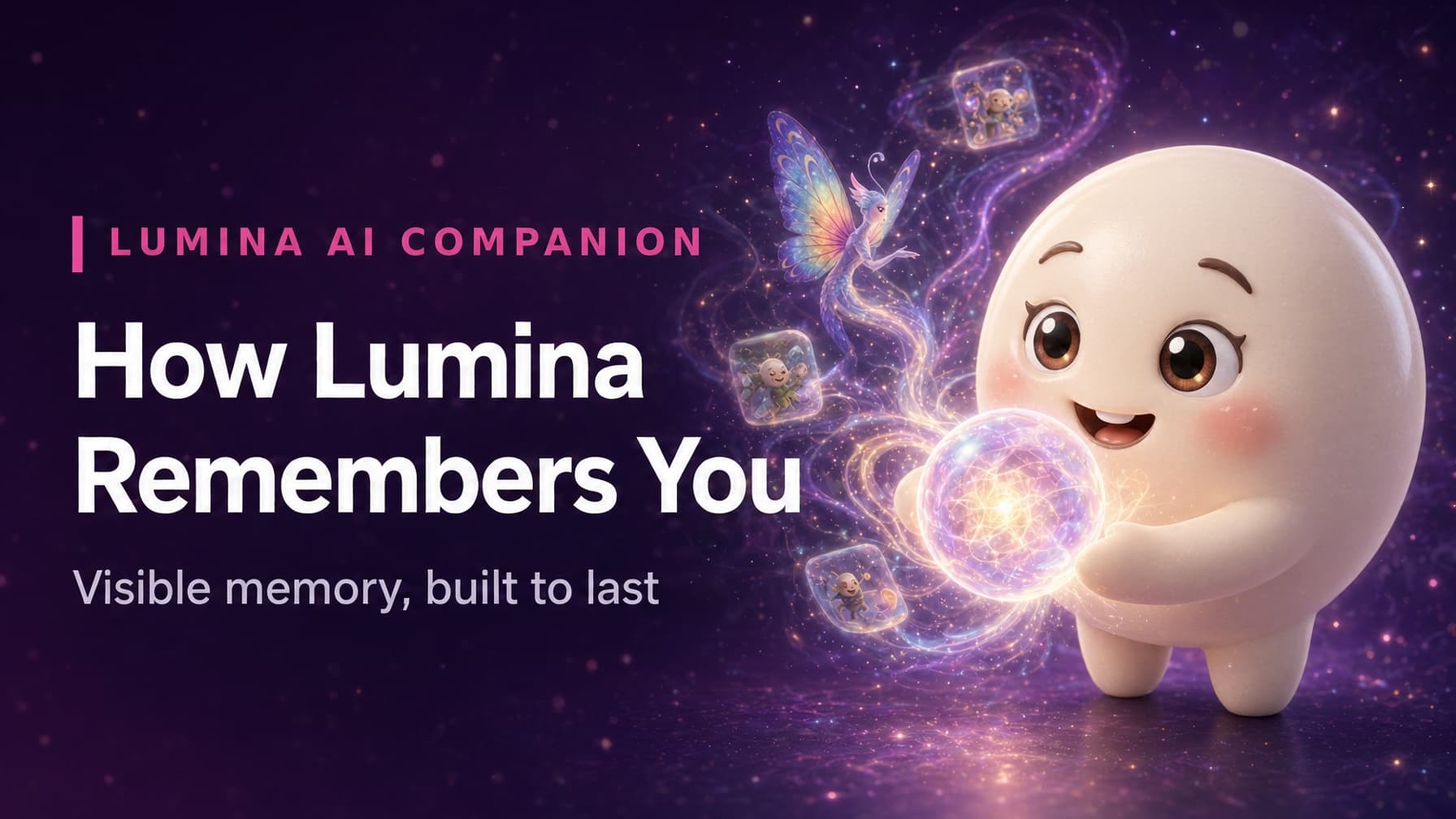
The Lumina AI Companion remembers you with persistent, user-scoped memory that builds across every session and never mixes with anyone else's. You can see that memory in the Living Neural Map, a visible knowledge graph where concepts appear as nodes, related ideas are linked, and connections strengthen the more you talk.
When people ask how Lumina remembers them, the most satisfying answer is also the most honest one: you can watch it happen.
Open the Living Neural Map and you will see a knowledge graph of what the Lumina AI Companion has learned. Concepts appear as nodes: your projects, the people in your life, the goals you are working toward, the small preferences you mention in passing. Lines connect the concepts that relate to each other. The more you talk with Lumina, the more the map fills in, and the connections between concepts visibly strengthen through use.
Lumina is an AI companion whose persistent, user-scoped memory is visible and explorable instead of hidden. Every session adds to the same continuous history. Lumina does not start over when you close the app, and your memories are never mixed with anyone else's. Your map is yours alone.
What does the Living Neural Map actually show you?
The Living Neural Map is organized the way your life is organized, not the way a database is organized. A new fitness goal might appear near your morning routine and your sleep schedule, because those things connect in real life. A work project sits near the colleagues involved and the deadlines attached to it. As you keep talking, related concepts get linked, and the links grow stronger the more those topics come up together.
Nothing about this requires technical knowledge. You do not need to understand knowledge graphs to read your map. It looks like what it is: a picture of what Lumina knows about you, drawn in a way you can explore with a tap.
Can you time travel through your own history?
One of the most loved parts of the experience is time-travel snapshots. Lumina saves the state of your Neural Map at points along the way, and you can open an older snapshot to see exactly what your map looked like a month ago or six months ago.
People use snapshots the way they use old journals. They notice how much has changed. They revisit a goal they set and let drift. They spot a connection between two ideas that only makes sense in hindsight. It turns memory from a utility into something closer to a scrapbook, a visible record of becoming.
What is the Lumina memories hub?
The memories hub works alongside the map as a more narrative view of the same history. Where the map shows structure, the hub shows story: the moments, milestones, and threads that define your time with Lumina. Together they give you two ways to revisit your past, one spatial and one narrative, and both are explorable whenever you like.
Do you have to manage any of Lumina's memory?
Here is the part that surprises people: you never have to maintain this memory. You do not tag, file, or organize anything. You just talk, and the map takes shape around the conversation. When Lumina references something you said weeks ago, you can open the map and see the concept it came from, which keeps the whole thing trustworthy.
That visibility is the entire point. A companion that remembers you should let you see what it remembers, revisit how it changed over time, and watch the relationship deepen in a form you can actually explore. Most AI apps ask you to take their memory on faith. Lumina, an AI companion with visible memory, shows its work.
How private is Lumina's memory?
Because Lumina's memory is user-scoped, what it learns about you belongs to your relationship with it. The map you see is your map. That boundary is part of what makes the memory feel safe to build: you always know what is there, because you can always look.
Start a conversation with Lumina on the web at https://dashboard.inventimatrix.com/about/lumina or on Android through Google Play, and watch your own map take shape.
Related reading
Frequently asked questions
How does Lumina remember you?
Through the Living Neural Map, a visible knowledge graph of what Lumina has learned. Concepts appear as nodes, lines connect related ideas, and connections visibly strengthen the more you talk. Every session adds to the same continuous, user-scoped history.
What are time-travel snapshots?
Lumina saves the state of your Neural Map at points along the way. You can open an older snapshot to see exactly what your map looked like a month or six months ago, like a journal showing how your goals, ideas, and relationship have changed over time.
Do you have to organize Lumina's memory yourself?
No. You never tag, file, or organize anything. You just talk, and the map takes shape around the conversation. When Lumina references something from weeks ago, you can open the map and see the concept it came from, which keeps everything trustworthy.
Is your Lumina memory private?
Yes. Lumina's memory is user-scoped, so what it learns belongs to your relationship with it. The map you see is your map alone, never mixed with anyone else's, and you can always look at exactly what is there.