Lumina vs Replika: which AI companion actually remembers you?
Replika and Lumina both remember you across conversations, but they show that memory differently: a list of saved memories versus a Living Neural Map you can explore.
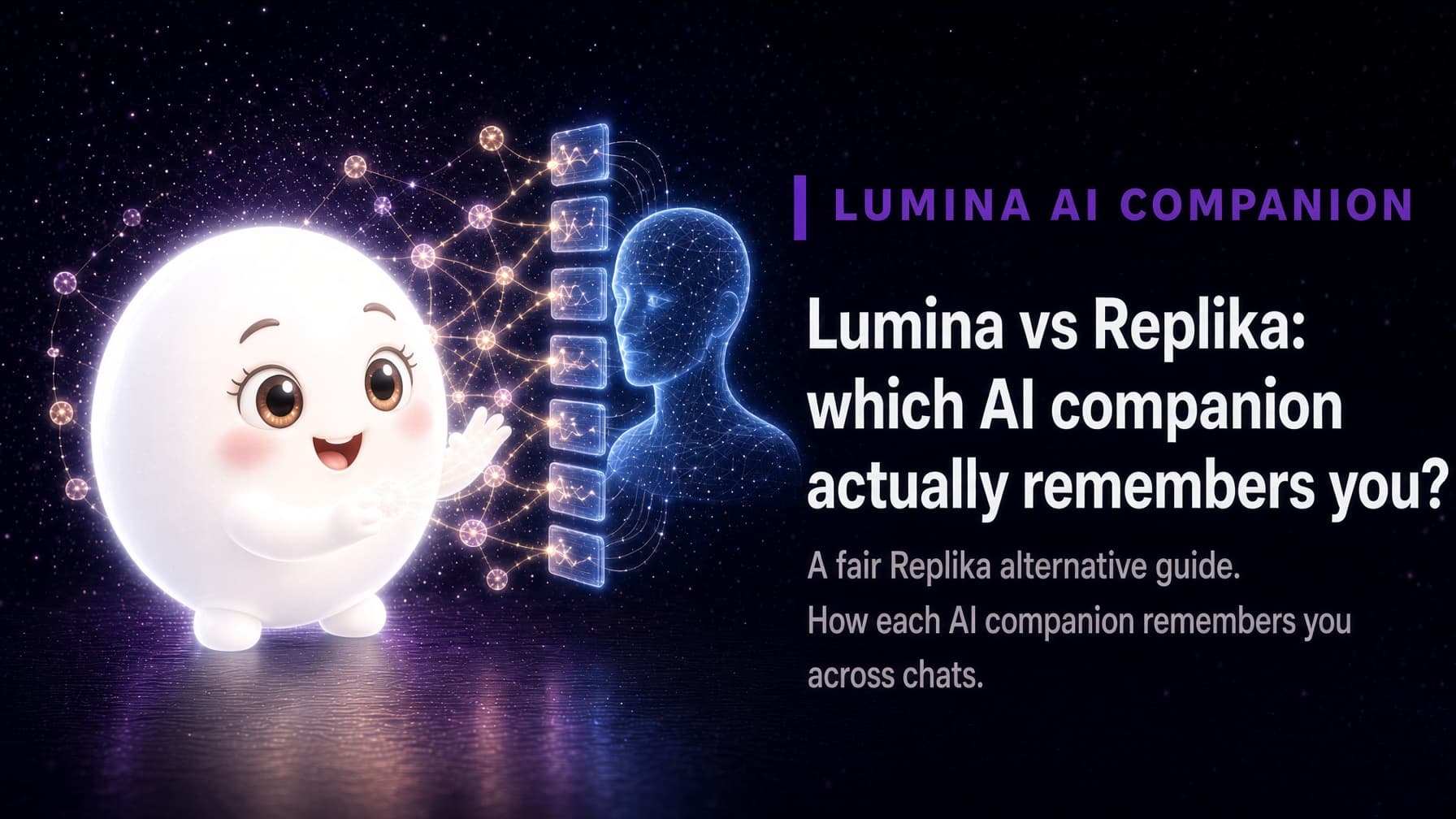
Replika and Lumina AI Companion both keep memory across conversations. Replika saves facts about you and lists them in a Memory section you can review and remove. Lumina shows what it has learned as a Living Neural Map, a visual web of connected concepts with time-travel snapshots of how it changed.
A quick note before we compare: Physis Systems makes Lumina, so read this as a product maker's view. We have kept the Replika details to what Replika publicly describes, and we encourage you to try both.
What are Replika and Lumina?
Replika is one of the best-known AI companion apps. You create a companion, talk with it by text, and over time it learns about your interests and the people in your life.
Lumina is a personal AI companion app from Physis Systems that grows with you. It keeps a persistent, user-scoped memory across sessions, so what you talked about yesterday can inform today's conversation. Alongside conversation, Lumina includes a memories hub, reflective features, cognitive mini-games, and everyday help with calendars, priorities, and notes.
Both are built around the same idea: a companion should know you better over time, not start from zero every time you open the app.
How does Replika remember you?
According to Replika's help center, your Replika remembers profile details you provide, such as your name, and tends to remember things like your favorite books, music, movies, and hobbies, plus the friends and family you mention.
Some of those memories are visible. From your Replika's profile you can open a Memory section, scroll through what it has saved, read each memory, and remove ones you do not want kept. Replika also describes memory in layers: beyond the saved list, a deeper system draws on patterns from your overall conversation history. You can also simply ask your Replika what it knows about you.
How does Lumina remember you?
Lumina keeps one continuous, private memory for each user. Every session adds to it, and it is never mixed with anyone else's.
That memory is shown as the Living Neural Map. Concepts from your conversations appear as nodes, such as your projects, the people you mention, and your goals. Lines connect related concepts, and those connections strengthen the more the topics come up together. Time-travel snapshots let you open an earlier version of the map to see how it looked a month or six months ago. The memories hub adds a narrative view of moments and milestones.
You do not have to tag or organize anything. You talk, and the map takes shape around the conversation.
Is the difference a list of memories or a map?
This is the real distinction, and it is about format more than whether memory exists.
- Replika gives you a list: individual saved memories you can read and remove, plus memory that Replika says is not all listed.
- Lumina gives you a map: how the things it has learned connect to each other, and how that picture has changed over time.
A list is simple to scan and edit. A map makes relationships between ideas visible, and snapshots make change over time visible. Neither approach means an app remembers everything perfectly, which no AI does. The question is how clearly you can see and check what it has kept.
Which should you choose if memory matters most?
Framed purely on memory, the choice depends on what you want to see:
- If you want a straightforward list of saved facts that you can prune, Replika's Memory section fits that style.
- If you want to see how your conversations connect, and how your shared history has grown week by week, Lumina's Living Neural Map and time-travel snapshots are built for exactly that.
Features in both apps change over time, so check each app's current version before deciding. The simplest test works for either: share a few details, come back a few days later, and see what it remembers and whether you can verify it.
For more on how Lumina's memory works, read How Lumina remembers you.
How can you try Lumina?
Lumina: AI Companion is available on Android through Google Play. Download Lumina on Google Play and start a conversation it will remember next time. The iOS version has been submitted to the App Store and is waiting for review.
Frequently asked questions
Is Lumina a good Replika alternative?
It can be, especially if memory is what you care about most. Both apps remember you across conversations. Lumina shows its memory as a Living Neural Map with time-travel snapshots, while Replika keeps a list of saved memories you can review. Trying both is the fairest way to decide.
Can you see what Replika remembers about you?
Yes, partly. According to Replika's help center, saved memories appear in a Memory section where you can read or remove them, and you can ask your Replika what it knows about you. Replika also says some memory draws on broader patterns from your conversations that are not listed there.
Can you see what Lumina remembers about you?
Yes. Lumina's memory is visible and explorable through the Living Neural Map, which shows the concepts it has learned and how they connect. Time-travel snapshots let you look back at how your map looked weeks or months ago.
Is Lumina available on iPhone?
Not yet. Lumina is available on Android through Google Play and on the web. The iOS version has been submitted to the App Store and is waiting for review.